About Downham

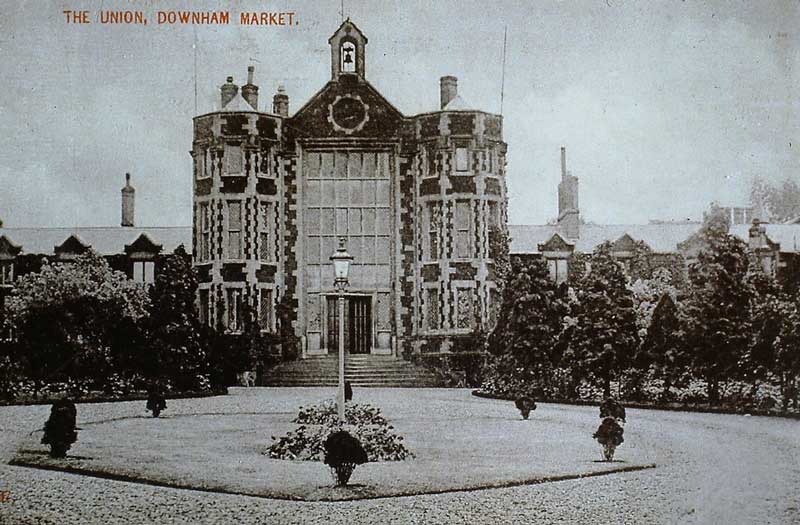
Downham Market Union Workhouse, London Road, Downham Market, T W Mollard collection, (bob)

Discover Downham

Discover Downham is run by the Downham Market & District Heritage Society.

The Society operates as a not-for-profit social enterprise, raising funds through donations, membership fees, admission charges for talks and visits, room hire, and the sale of postcards and notelets depicting local scenes painted by one of its members.

The primary aims and objectives are:

To promote interest in and awareness of the historical heritage of Downham Market and the surrounding villages that make up the ancient administrative area of the Clackclose Hundred. This area includes 34 villages and the town of Downham Market, the original administrative centre.

To collect and preserve artefacts and documents relating to the area.

To provide an educational resource for local people, schools, and visitors. Education of the younger generation is at the forefront of our aims, while also keeping the older generation well-informed about the history of the area. Downham Market has a large population of retired people, many of whom have moved here from other parts of the country.

To promote the preservation of the natural, built and historical heritage of the area.

To collect and publish information for visitors and residents so they can easily access all that is of interest in Downham Market and its surroundings.

In addition, we undertake research in response to requests from both home and abroad. The fee for this service is £10 per hour of research, with a minimum charge of £10 for all enquiries. If an enquiry is expected to take longer than the initial hour, the enquirer will be notified in advance for agreement. Otherwise, acceptance will be assumed unless the enquirer states otherwise.

Initial enquiries should be made by calling Discover Downham on 01366 384428 or by emailing info@discoverdownham.org.uk. Please provide your full contact details along with a clear description of the subject you would like researched.

To date, most of our work has focused on Downham itself, but research into the surrounding villages is progressing. We are always keen to gather more historical information about our area and welcome contributions from other historical groups as well as individuals. If you have anything you would like to share with us, please do get in touch.

History of the Society

We, the Society, were originally formed in September 1995 with the express aim of acquiring the Old Court House and developing it into a museum for the area around Downham Market.

The Court House building had become vacant and was put up for sale after the business of the Magistrate’s Court at Downham Market was transferred to King’s Lynn. It was considered ideally suited to provide a centre where the history of the town could be recorded, displayed, and researched. Unfortunately, we were unable to raise sufficient funding to make an offer. The building was neglected for several years before being rescued by a private buyer. In hindsight, it was probably just as well that we were unable to proceed, as considerable work would have been required to repair the deterioration and damage caused by neglect. Nevertheless, the Society had been founded.

Other possible sites were then investigated, but the problem of securing sufficient funding (or indeed any at all!) thwarted our every move. After seven years of constant but unsuccessful attempts to find a home, it was decided that the Society should be mothballed for a while, giving us time for reflection before renewing our efforts.

By September 2002, although we had been raising money for our dream, it was decided that we should abandon the project and think carefully about our future direction and what we should do with the money we had banked. Then, out of the blue, the Borough Council – having received money for the Regeneration Scheme – sought to improve and expand the use of Downham’s Town Hall. Notably, they wished to make use of the internal balcony, which had been dead space, and this was offered to us as a home.

Rapid developments followed, including the successful application for grants to fund the twelve glass display cases we currently use and the twelve display/story boards telling the story of the town. By midsummer 2003, after some initial problems, everything was in place, and all we needed were items to display. A slow trickle of objects on loan from townspeople, Society members, the Town Council, and various other sources soon grew into a steady flow, enabling us to set up our first displays and open to the public.

Since then, we have flourished and successfully achieved our aim of creating a centre dedicated to the heritage of the Clackclose Hundred. Discover Downham was officially opened on 20 May 2016 by Elizabeth Truss, local MP and Secretary of State for Environment, Food and Rural Affairs.

Membership currently stands at just under one hundred, with members supporting our activities through a range of initiatives, including a programme of monthly talks. We are a not-for-profit social enterprise, raising funds through donations, membership fees, admission charges for talks and visits, and sales in the shop. All receipts are reinvested in the running of Discover Downham.

Volunteers are responsible for running Discover Downham, and anyone with an interest in the history of the town is warmly welcomed to join the team.

Villages of the Clackclose Hundred

The Clackclose Hundred was one of Norfolk’s ancient administrative divisions, a structure rooted deep in the Anglo-Saxon era when the kingdom sought to organise justice, taxation and local governance through hundreds. Stretching across more than thirty villages around Downham Market, Clackclose once formed a broad sweep of countryside that ran for some seventeen miles north to south and up to fifteen miles in width. Its landscape was remarkably varied: to the east and south lay higher, fertile ground dotted with woodland and substantial settlements, while to the west and north the land dipped into the fen margins, shaped by the waters of the Great Ouse and the tributary rivers Wissey and Nar. Over the centuries these marshlands were drained and reclaimed, transforming the area into rich agricultural land.

The hundred was far more than a boundary on a map. It was an active unit of authority, possessing its own court held at Clackclose Hill on Stradsett Common. By the reign of Edward I the Abbot of Ely exercised baronial control here, able to issue writs, oversee frankpledge and even maintain a prison and gallows at Wimbotsham. The hundred court met every three weeks for routine matters, with larger sessions held at Easter and Michaelmas, drawing people from across the many communities that made up Clackclose.

Among these were parishes such as Fincham, a major Domesday settlement of more than 160 households, and Bexwell, with its lands divided among powerful Norman lords and religious houses. Together these villages formed a tightly woven network shaped by shared laws, trade, waterways and centuries of common history. The boundaries of Clackclose remained remarkably stable from the Domesday survey onward, evidence of its enduring administrative and social coherence.

Though hundreds faded from official use long ago, the legacy of Clackclose has never entirely disappeared. The name survives in roads, historic properties and local memory. Discover Downham continues to celebrate the stories of the thirty-plus villages that were once held within its jurisdiction, keeping alive the narrative of an area shaped by fenland transformation, medieval justice and a thousand years of continuous settlement. The Clackclose Hundred may no longer administer law or governance, but its imprint remains unmistakably woven into the landscape and identity of this corner of Norfolk.

The thirty-four villages that composed the Clackclose Hundered were: Barroway Drove; Barton Bendish; Beachamwell; Bexwell; Boughton; Crimplesham; Denver; Downham Market; Eastmoor; Fincham; Fordham; Gold Hill; Hilgay; Hilgay Fen; Holly End; Iron Bridge; Lakesend; Marham; Nordelph; Outwell; Roxham; Runcton Holme; Ryston; Shingham; Shouldham; Shouldham Thorpe; South Runcton; Southery; Stoke Ferry; Stow Bridge; Stradsett; Ten Mile Bank; Thorpeland; Three Holes; Tipps End; Tottenhill; Upwell; Upwell Fen; Wallington cum Thorpland; Watlington, Welney; West Dereham; West Head; Wimbotsham; Wissington; Wormegay and Wretton.